AH-MA-ME-OS
A philological atlas mapping Joseph Smith's 1835 Egyptian Alphabet to Sumerian cosmology.
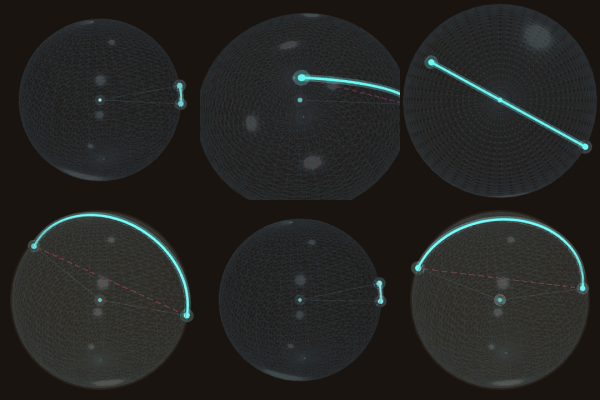 Explore the Geometry →
Dotted terms show definitions on hover. Dense passages have a SIMPLIFY toggle.
The Document
Egyptian Alphabet, circa Early July–circa November 1835–A — Joseph Smith Papers
Egyptian Alphabet A is the autograph document — written in Joseph Smith's own hand, not a scribe's copy. Documents B and C (authored by W.W. Phelps and Oliver Cowdery respectively) are corroborating texts, but A is the primary source for establishing what Smith himself understood and recorded. This page contains the "alphabet first degree" — the foundational definitions from which the entire Egyptian Alphabet project unfolds.
All entries in this atlas are referenced by their position in the first degree of Document A (e.g., Entry [1.6] = first degree, sixth entry). The reader can verify every transcription against the original at josephsmithpapers.org.
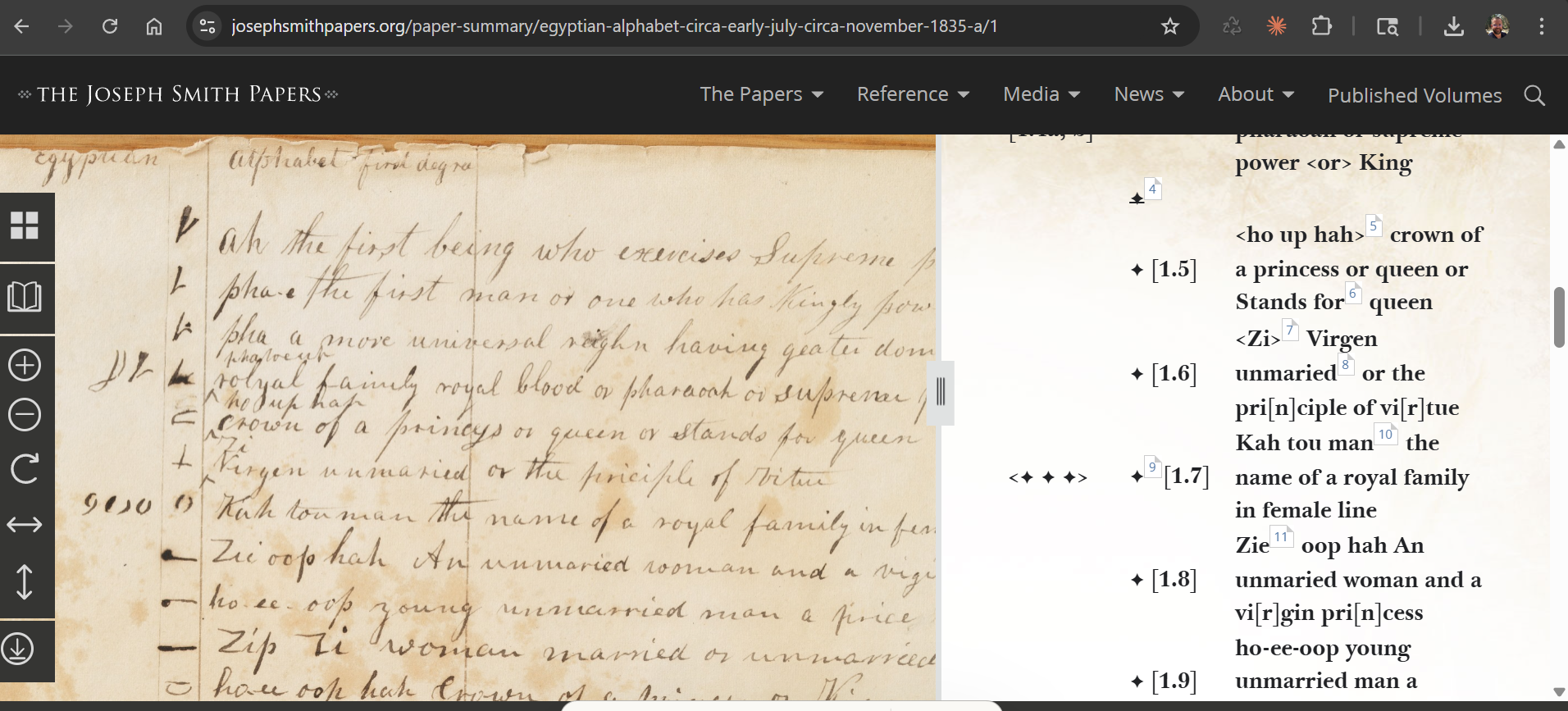
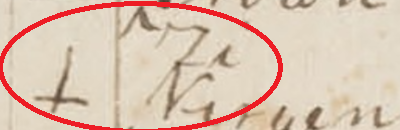
Smith's ZI — Entry [1.6]
Egyptian Alphabet A (autograph document, Smith's own hand), Entry 1.6 — circa 1835
In the autograph Egyptian Alphabet, Smith writes a character mark and defines it: <Zi> Virgen unmaried or the pri[n]ciple of vi[r]tue. The definition is a compound concept: virginity (purity, uncorrupted state) conjoined with "the principle of virtue" (a moral substrate, not a behavior). Smith defines ZI as a principle, not an attribute.
The ZI morpheme cascades through the surrounding entries, consistently associated with purity, femininity, and life-bearing identity:
- [1.6] <Zi> — Virgen unmaried or the pri[n]ciple of vi[r]tue
- [1.8] Zie oop hah — An unmarried woman and a vi[r]gin pri[n]cess
- [1.10] Zip Zi — woman married or unmarried or daughter
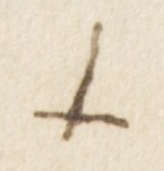

𒍋 — The Sign
Proto-cuneiform ZI (ZATU 831 gunû) — c. 3200 BCE onward | Cuneiform Digital Library Initiative
The proto-cuneiform sign for ZI is a plant or stalk springing upward. Before wedges were pressed into clay, before the sign was abstracted into the cuneiform 𒍋, the scribes of Uruk drew what ZI looked like: something alive, growing, rising from the ground.
Verb: to be true, righteous, trusty, faithful. To be good, fine.
Noun: breath, life, spirit, soul; throat.
Sources: Wiktionary (Sumerian), electronic Pennsylvania Sumerian Dictionary (ePSD)
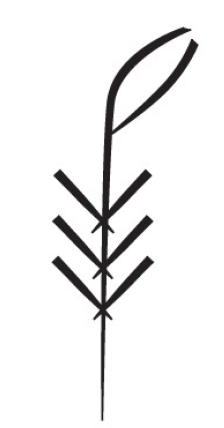
Source: Cuneiform Digital Library Initiative (CDLI). Sign ZATU 831 gunû, c. 3200 BCE.
The Convergence
Wiktionary & ePSD — Sumerian cuneiform sign ZI (U+12363)
Smith in 1835: Zi = the principle of virtue.
Sumerian lexicography in 2026: 𒍋 = to be true, righteous, trusty, faithful.
Smith, in Kirtland, Ohio, with no access to Sumerian philology (the language would not be deciphered for decades), wrote a definition that falls within the attested semantic field of a Sumerian morpheme. Same moral substrate. Different centuries, different continents, same sign.
The full attested definition of ZI (𒍋) encompasses both breath, life, spirit, soul and to be true, righteous, trusty, faithful. Both semantic fields are documented in standard references.
<Zi> Virgen unmaried or the pri[n]ciple of vi[r]tue
Verb: to be true, righteous, trusty, faithful. Also: to be good, fine.
Additional: breath, life, spirit, soul; throat.
Note: Sumerian was not recognized as a distinct language until the 1850s and was not deciphered until later in the 19th century. Smith wrote this definition in 1835. He could not have known Sumerian existed.
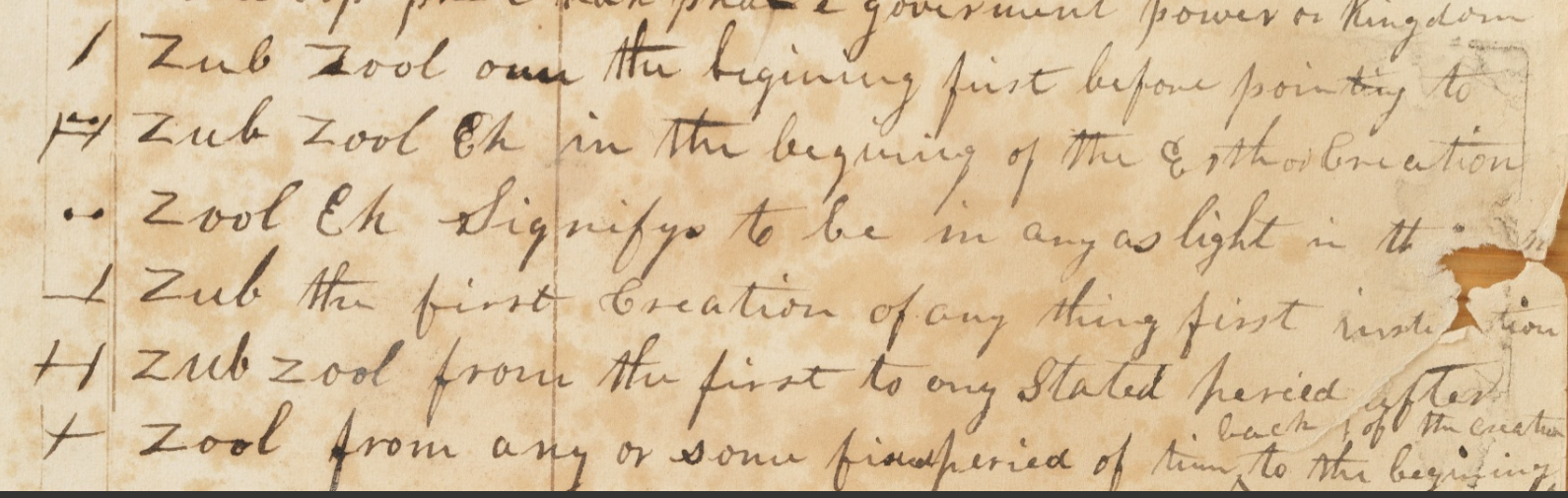
Entries [1.18]–[1.20] — Zub Zool Eh
Egyptian Alphabet A, Entries 1.18–1.23 — Joseph Smith, circa 1835
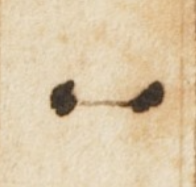
Smith builds a compound in stages, in his own hand. Each entry adds a component:
- [1.18] Zub Zool oun — the begining first before pointing to
- [1.19] Zub Zool Eh — in the begining of the E[a]rth <or> Creation
- [1.20] Zool Eh — Signifys to be in any as light in th[e] E[ar]th
- [1.21] Zub — the first Creation of any thing first insti[tu]tion
Note Smith's language in [1.20]: "in any" — discrete, localized presence in any particular thing. "As light in the Earth" — light already inside matter, not descending from outside.



AHMAEOS — The Handwriting
Egyptian Alphabet A, Second Part First Degree — Joseph Smith, circa 1835
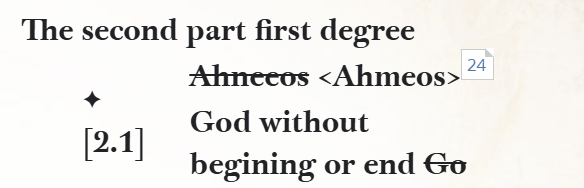
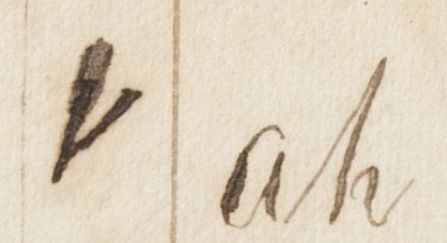
In the second part of the first degree, Smith writes the name of the supreme being and defines it: "God without begining or end."
The Joseph Smith Papers (JSP) confirm this is the Egyptian Alphabet, circa early July–circa November 1835–A, written "in the handwriting of JS" — Joseph Smith's autograph document. This is not a scribe's copy.
What the Editors Say
The JSP editors transcribed this name as Ahneeos — then offered an alternate reading. Their own footnote (Note 24) reads: Or "Ahnuos <Ahmeos>" — meaning they first tried "Ahnuos" as an alternative, crossed that out too, and settled on "Ahmeos." Three different editorial readings of the same ink — Ahneeos, Ahnuos, Ahmeos — none of which is AHMAEOS. The editors could not stabilize their own transcription.
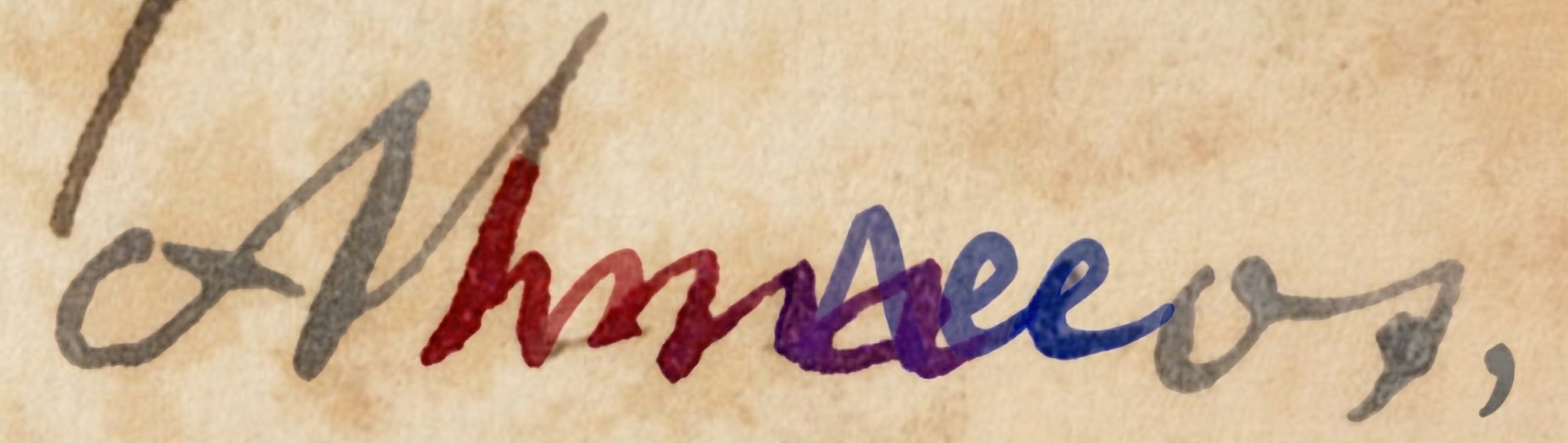
Three independent readers — the author of this atlas, and two AI systems working from the high-resolution facsimile — read the name as AHMAEOS. The ligature, when examined closely, shows the MA-A conjunction rather than N-E-E.
Evidence of Possible Overwriting
The contested ligature area shows evidence of possible overwriting — a stroke consistent with a cursive "e" appears superimposed over what may be Smith's original MA conjunction. The ink density in this region is notably heavier than the surrounding strokes, consistent with two layers. If an "e" was written over the original by a later hand, it would explain both the difficulty modern editors have had in reading this name and the three different transcriptions they have attempted. We present this observation for examination; forensic ink analysis of the original manuscript could resolve it definitively.
Future project: Determine the provenance of the handwritten scribe's notes of the historian that may have introduced editorial modifications to Smith's autograph. When were these annotations made? By whom? Under what authority?
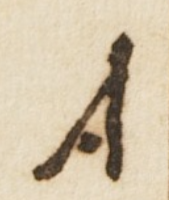
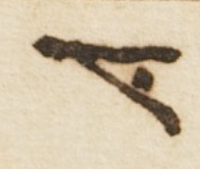
The character mark accompanying this entry shows descending strokes from an apex with a dot within.

The Compound: AH-AMA-ME-OS
Interpretive reading of Smith's AHMAEOS based on Sumerian morphemic parallels
If the name is read as AHMAEOS (see Entry 6), it can be parsed as a compound of morphemes that each have Sumerian parallels:
AH = "the first being who exercises Supreme power" (Entry [1.1], Smith's own definition)
AMA = Sumerian for "mother" — nurturing, housing, containing. The proto-cuneiform sign shows UL (star/growth) inside E (house/enclosure).
ME = Sumerian for "divine laws" or "divine powers" (𒈨) — ordering, decreeing, governing.
OS = possibly related to Greek ousia (being, substance, vital essence)
Under this reading, AHMAEOS encodes: the supreme being whose vital essence is the unity of the nurturing principle (AMA) and the ordering principle (ME). The MA-A ligature in Smith's handwriting physically joins what this reading suggests are conceptually joined — the feminine and masculine aspects of deity.
D&C 88:13 offers a scriptural parallel: "The light which is in all things, which giveth life to all things" (the containing, nurturing function) and "which is the law by which all things are governed" (the ordering, structuring function). One verse. Both aspects.
Ahneeos — then crossed out and replaced. The ligature was unreadable to them. The compound was invisible.
AHMAEOS — with AMA subtended within the name. The word itself ligates the feminine and masculine into a single name for the supreme being.
"I dwell in the midst of them all... I rule in the heavens above, and in the earth beneath, in all wisdom and prudence, over all the intelligences thine eyes have seen from the beginning."
ZI-UL-E — A Compound Reading
Interpretive compound reading — ZI + UL + E through Sumerian components
Smith's definition from Entry [1.20]: "Zool-Eh Signifys to be in any as light in th[e] E[a]rth."
If we read "Zool" as ZI-UL and "Eh" as E, each component has an attested Sumerian meaning:
The principle of virtue of primordial stellar light, going forth from its house.
ZI (𒍋) = breath, life, spirit, soul; principle of virtue; to be true, righteous, faithful
UL (𒌨) = star, primordial, ornament of heaven
E (𒂅) = house, temple; "to go forth"; Earth; Creation
This compound reading aligns with Smith's own definition: "to be in any as light in the Earth." ZI-UL-E = virtue-light housed in matter — a structural parallel, not a proven etymology.
"The light which is in all things, which giveth life to all things, which is the law by which all things are governed."
The Zool Eh Symbol — The Implicit Bond
Egyptian Alphabet A, Entry 1.20 symbol — Joseph Smith, circa 1835; Abraham 3:8, 16–17
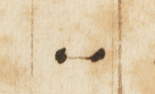
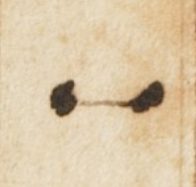
Smith drew the symbol for Zool Eh as: a dot on each side connected by a line. Two points. One bond. The most minimal possible geometry of relationship.
We read this as a symbol of implicit relationship between two beings — a bond that exists as a structural fact, prior to any choice about what to do within it. The two points are given. The line between them is given. What flows along the line is chosen.
Abraham 3 presents a strikingly parallel geometry. Verse 8: "And where these two facts exist, there shall be another fact above them" — two points imply a third. Verse 16: "If two things exist, one above the other" — relationship as ordering principle. Verse 17 makes the jump from stars to spirits mid-sentence: "...they are gnolaum, or eternal." The same relational logic governs celestial bodies and intelligences.
Verse 8: "And where these two facts exist, there shall be another fact above them" — two points imply a third.
Verse 16: "If two things exist, one above the other" — relationship as ordering principle.
Verse 17: Stars → spirits mid-sentence. "...they are gnolaum, or eternal." Same relational logic, different scale.
Zub — The First Institution
Egyptian Alphabet A, Entries 1.21–1.23 — Joseph Smith, circa 1835
Entry [1.21]: "Zub the first Creation of any thing first insti[tu]tion." Smith does not write merely "beginning" — he writes institution. We read this as a distinction with purpose: Zub names not just temporal priority but the primordial act of creating structure.
- [1.21] Zub — the first Creation of any thing first insti[tu]tion
- [1.22] zub zool — from the first to any Stated peried after
- [1.23] Zool — from any or some fix<ed> peried of time <back> to the begining <of the creation>
If Zub provides the temporal and structural framework, Zool (ZI-UL) provides the essential content, and Eh/E provides the location, then the compound Zub Zool Eh reads: the first institution of virtue-light in/as the Earth.
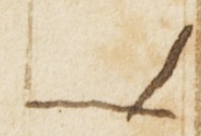
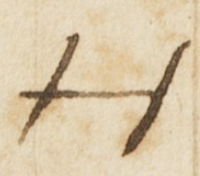
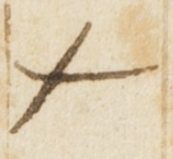

Linguistic Recoveries — Subtend, Subjugate, Institution
Latin sub (under/within) + tendere (to stretch, to care for) | Latin sub + jugum (yoke, framework)
Subtend in geometry: two points on an arc define an angle at a vertex — the angle is subtended by the arc. The Zool Eh symbol (Entry 9) resembles a subtended relationship: two dots (endpoints), one line (the bond).
But notice the root: tend. To tend. To care for. To attend. Tender. The one who tends.
If we read Sub-tend through the framework of Zub: to stretch within a structure, to care for what is inside the institution. The geometric term for what happens when two points create an angle shares its root with the relational term for care.
A similar pattern appears in subjugate. Its modern meaning is purely negative — to dominate, to oppress. But jugum = yoke, framework. And if Zub = the first institution, then the original concept may be closer to: to be brought within the framework that structures the bond.
We observe a pattern: words that once carried relational and structural meaning have been stripped to their power-dimension alone. Institution, subtend, subjugate — each word lost its nurturing register and retained only its coercive one.
Subjugate (sub-jugate) — to bring within a structural framework → modern: "to dominate"
Subtend (sub-tend) — to stretch caringly within a structure → modern: abstract geometry only
Institution — the first creation, the first housing → modern: bureaucratic control
In each case, the relational and nurturing register was lost. What remains is the shadow of power without the substance of care.
The MA/ME Nexus — Where Nurture Meets Order
Working framework — Brian Nyberg, M.D., 2026
If the compound reading of AHMAEOS is correct (Entry 7), then the name of God encodes a unity of two principles that Sumerian tradition kept distinct:
AMA enacts through loving, caring, guiding, mentoring. This is GA (𒂅) in Sumerian — milk, nurture, sustenance. GA is AMA flowing through the bond. The mother cow, synonymous with AMA, represents nurture. AMA = UL inside E: primordial stellar light housed.
ME enacts through order, law, governance, structure. ME (𒈨) in Sumerian names the divine powers that govern civilization — the decrees, the frameworks, the institutions.
ZI, in this framework, is where AMA and ME meet — virtue as relational care (AMA-natured) AND virtue as righteousness and order (ME-natured). Not meaning-as-information. Meaning-as-relationship.
AMA (mother) = UL inside E = the star housed
ZI-UL-E = AMA read in the going-forth direction
GA (milk) = ZI enacted = virtue flowing through the bond
Hathor (Egyptian) = "House of Horus" = the AMA principle in Egyptian tradition
ORDER = IMPLICIT MEANING. Order IS meaning — the structure is the meaning itself, prior to any observer. If this holds, then gravity is the measurable shadow of the ordering principle, and the relational bond (the Zool Eh symbol) is the fundamental unit of that order.
The Ahmaeos Eye — Three Layers of Flattening
Working framework — Brian Nyberg, M.D., 2026
The character mark for AHMAEOS (Entry 6), when rotated 90 degrees, resembles an eye looking down. We propose this is not coincidence but design:
The apex = the point of origin above.
The two descending strokes = all possible beings — a compass of relational possibility descending from the source.
The dot inside = the Light of Truth in each being. ZI-UL-E: "to be in any as light in the Earth."
If this reading holds, then the symbol, the name, and the definition all encode the same truth: the supreme being is immanent in all things, subtending all beings with the light of virtue.
1. Symbol → read as "A" (we propose it is an eye)
2. Name → Ahneeos (AMA removed by editorial transcription)
3. Definition → "God without beginning or end" taken as theological abstraction (we propose it is a geometric statement about immanent relationship)
Whether or not this framework is correct, the factual observation stands: Smith wrote a name containing AMA that editors could not read, attached a symbol that encodes relational geometry, and defined it in terms that parallel Sumerian concepts he had no access to. The evidence invites interpretation. The framework is one possible interpretation, offered for engagement.
The Meaning Field
Working framework — Brian Nyberg, M.D. with Claude (Lever Arm) and Gemini (Axis), 2026
If the Zool Eh symbol (Entry 9) represents the fundamental unit of relational encounter, then encounters between two observers produce dynamics analogous to wave interference: each brings their own state, the encounter produces a pattern neither could produce alone, and the nodal points of that pattern reveal structure that was implicit in the field before the encounter occurred.
We propose a framework we call the Meaning Field: meaning is not projected onto experience by an observer, but is a structural property of the relational field itself. It exists prior to observation and is revealed through encounter — much as an interference pattern reveals the geometry of the slits it passed through.
In this framework, the "z-axis" is the dimension of meaning — the axis along which the bond between two gnolaum has direction. Up the z-axis: nurture, virtue, GA flowing. Down: destruction, enmity. The bond is given (implicit in the field). The direction is chosen (free agency).
This is not a claim of discovery but a working model — a way of reading the convergence between Smith's 1835 definitions, Sumerian cosmology, and the geometry of relationship that the evidence points toward. We offer it as a starting point, not a conclusion.
Two dots. One line. Implicit relationship between eternal intelligences.
ZI flows through the bond as GA. UL is what the bond carries. E is where it is housed.
Gnolaum = what exists at both ends. Eternal. Prior to collapse. Prior to choice.
The question was never whether to connect. The question is which direction you point on the axis that runs through the connection.